
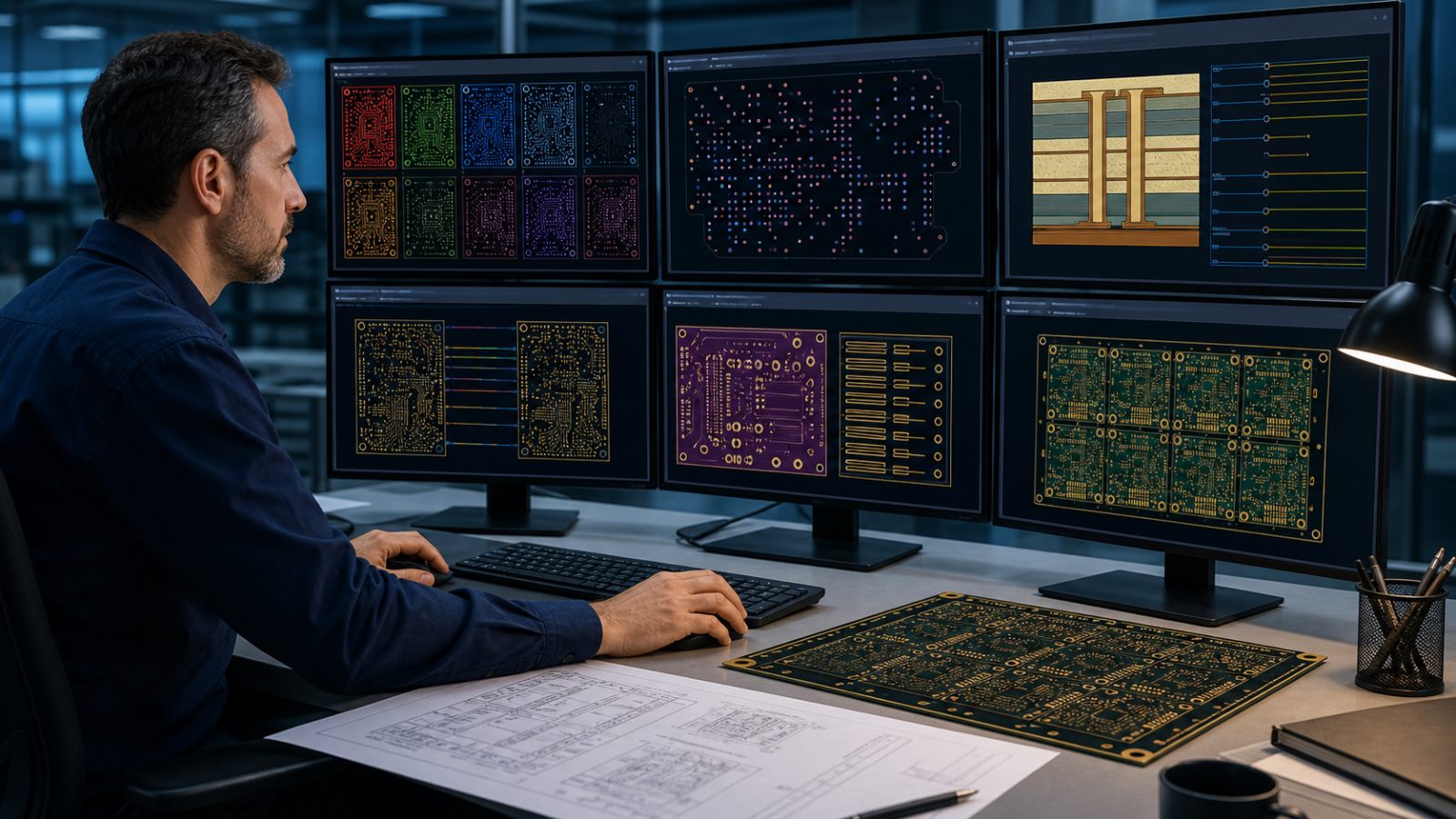
PCB CAM outsourcing helps printed circuit board manufacturers access additional engineering capacity, specialised technical skills, and flexible production support without relying entirely on an in-house team. As PCB designs become more complex and manufacturing schedules become tighter, outsourcing CAM engineering can help businesses manage workload fluctuations, maintain processing efficiency, and reduce engineering bottlenecks.
From front-end processing and design for manufacturability (DFM) analysis to panelization and manufacturing data preparation, an external CAM engineering partner can support different stages of the PCB fabrication workflow. However, successful outsourcing requires careful evaluation of technical expertise, turnaround times, quality controls, communication, and overall cost.
This guide explains how PCB CAM outsourcing works, its key benefits, potential costs, common risks, and the factors PCB manufacturers should consider before selecting an outsourcing partner.
What Is PCB CAM Outsourcing?
PCB CAM outsourcing involves assigning some or all computer-aided manufacturing engineering tasks to an external engineering service provider. Instead of managing every CAM activity internally, a PCB manufacturer works with an external team to process design files, verify manufacturing data, perform DFM checks, prepare panelization layouts, and generate production-ready outputs according to agreed requirements.
The exact scope depends on the manufacturer's needs. Some businesses outsource specific activities during peak workloads, while others establish ongoing partnerships to support their regular engineering operations.
Common PCB CAM outsourcing services include:
- PCB front-end engineering and data preparation.
- Gerber and ODB++ file validation.
- Design for manufacturability analysis.
- Layer sequence and board outline verification.
- Drill file and routing data preparation.
- PCB panelization and tooling preparation.
- Multilayer PCB data processing.
- Manufacturing output verification and documentation.
- Revision control and production data management.
Manufacturers can outsource individual tasks or engage an external team for a broader workflow. The right approach depends on internal capabilities, production volume, design complexity, delivery requirements, and the level of control the manufacturer wants to retain.
For a broader overview of the activities involved, explore PCB CAM engineering services.
Why PCB Manufacturers Consider CAM Outsourcing
PCB manufacturers must balance engineering accuracy, production deadlines, customer requirements, and operating costs. When the volume or complexity of incoming jobs increases, an internal CAM team may struggle to process every design package within the required timeframe.
Hiring additional engineers can address capacity limitations, but recruitment and training take time. Maintaining a large permanent team can also become expensive when workloads fluctuate.
PCB CAM outsourcing offers an alternative by allowing manufacturers to access external engineering resources according to their requirements. It can provide additional capacity during busy periods, specialist knowledge for complex designs, and support for maintaining consistent workflows.
Outsourcing is particularly relevant for manufacturers experiencing recurring engineering backlogs, expanding their customer base, handling specialised PCB designs, or looking to improve the flexibility of their operations.
Key Benefits of PCB CAM Outsourcing
1. Flexible Engineering Capacity
One of the main advantages of PCB CAM outsourcing is the ability to adjust engineering capacity as workload changes.
PCB manufacturers may experience seasonal demand, sudden increases in customer orders, or projects that require more engineering time than anticipated. An internal team designed around average workload levels may not always have enough capacity to handle these peaks.
An outsourcing arrangement can provide additional engineering resources without requiring the manufacturer to immediately recruit permanent employees.
Potential benefits include:
- Managing temporary increases in design processing volume.
- Reducing engineering backlogs during peak periods.
- Supporting new customer projects without immediately expanding headcount.
- Maintaining production workflows when internal resources are stretched.
- Adjusting support levels as business requirements change.
Manufacturers should define how additional capacity will be requested, allocated, and prioritised. Flexible capacity is most useful when the outsourcing agreement includes clear workload expectations and a practical process for handling urgent jobs.
2. Access to Specialist CAM Engineering Skills
PCB manufacturing involves technical requirements that vary according to board structure, material selection, design complexity, and fabrication processes.
Some projects may require experience with multilayer PCBs, HDI designs, controlled-impedance requirements, rigid-flex boards, or specialised tooling preparation. An internal team may not encounter every design type frequently enough to maintain expertise across all areas.
PCB CAM outsourcing can provide access to engineers with experience in specific manufacturing workflows and design requirements.
Depending on the provider's capabilities, specialist support may include:
- Complex multilayer PCB data processing.
- Advanced DFM checks.
- Gerber and ODB++ validation.
- Drill and routing data preparation.
- Panelization for different board configurations.
- Stack-up and fabrication requirement coordination.
- Manufacturing data review for specialised PCB designs.
When evaluating a provider, manufacturers should verify its actual experience with the relevant board types, file formats, equipment requirements, and manufacturing processes. A general claim of PCB expertise is not sufficient evidence of capability.
3. Improved Turnaround Time
Engineering delays can affect the entire PCB manufacturing schedule. If CAM processing takes longer than expected, fabrication may be postponed even when production equipment and materials are available.
Additional engineering capacity can help manufacturers process incoming jobs more efficiently, particularly when an internal team is handling multiple projects simultaneously.
An outsourcing partner may help improve turnaround by allocating suitable resources to specific tasks, managing defined queues, and supporting agreed delivery schedules.
However, outsourcing does not automatically guarantee faster processing. Turnaround depends on design complexity, file quality, available engineering resources, communication, and the time required to resolve design questions.
Before beginning an engagement, manufacturers should establish:
- Expected turnaround times for standard jobs.
- Separate timelines for complex designs.
- Procedures for urgent requests.
- Response times for technical clarifications.
- Escalation procedures for delayed projects.
- Reporting requirements for jobs in progress.
A reliable provider should communicate realistic timelines rather than promise the same delivery time for every design.
4. Better Control Over Engineering Costs
Maintaining an in-house CAM team involves more than employee salaries. Manufacturers must also account for recruitment, training, software, workstations, supervision, and ongoing professional development.
Outsourcing changes the cost structure by allowing businesses to purchase engineering support through an agreed commercial arrangement.
Depending on the engagement model, this may involve per-job pricing, hourly billing, dedicated engineering resources, or a monthly service agreement.
Potential financial advantages include:
- Reducing the need for immediate permanent recruitment.
- Matching engineering expenditure more closely to workload.
- Accessing specialist skills without building every capability internally.
- Managing short-term projects without long-term staffing commitments.
- Making engineering support costs easier to forecast.
The actual savings depend on pricing, utilisation, internal management requirements, rework, and the quality of delivered outputs. Manufacturers should compare total operating costs rather than looking only at the quoted outsourcing rate.
5. Greater Focus on Core Manufacturing Operations
PCB manufacturers need to coordinate engineering, production planning, fabrication, quality assurance, procurement, and customer communication.
When internal engineering teams spend too much time managing backlogs or repetitive processing tasks, other operational priorities may receive less attention.
An appropriate outsourcing arrangement can help distribute workloads and allow internal engineers to focus on activities that require their direct involvement, such as complex technical decisions, process improvement, customer-specific requirements, and production optimisation.
The objective is not simply to transfer work outside the organisation. It is to allocate tasks according to technical expertise, operational priorities, and business requirements.
6. Support for Business Growth
As a PCB manufacturer's order volume increases, its engineering workflow must scale accordingly. Without sufficient CAM capacity, growth can create longer queues, inconsistent turnaround times, and increased pressure on existing employees.
PCB CAM outsourcing can help businesses support additional projects while they assess longer-term staffing and operational requirements.
External support may be particularly useful when entering new customer segments, accepting more complex board designs, or managing overlapping production schedules.
Manufacturers should periodically review whether the outsourcing arrangement continues to meet their needs. As demand becomes more predictable, a hybrid model combining internal and external resources may offer the best balance of control, flexibility, and cost.
How Much Does PCB CAM Outsourcing Cost?
The cost of PCB CAM outsourcing varies according to the scope of work, design complexity, required turnaround time, service model, and level of technical support.
There is no single price that applies to every PCB manufacturer. A straightforward data preparation task may require substantially less effort than a complex multilayer design involving extensive DFM analysis, panelization, and multiple rounds of clarification.
Common PCB CAM Outsourcing Pricing Models
1. Per-Job Pricing
Under a per-job arrangement, the provider charges an agreed fee for processing a specific PCB design or manufacturing package.
This model can suit manufacturers with occasional outsourcing requirements or projects that have clearly defined deliverables.
Before agreeing on a price, confirm what the fee includes, such as file validation, DFM checks, tooling preparation, revisions, and final output verification.
2. Hourly Pricing
Hourly pricing charges for the engineering time used to complete assigned tasks.
It can be suitable for variable workloads, technical investigations, or projects where the full scope cannot be determined in advance.
Manufacturers should agree on how time will be recorded, when estimates require approval, and how additional work will be communicated.
3. Dedicated Engineering Resources
A dedicated resource model provides access to one or more engineers for an agreed period or workload.
This approach may suit manufacturers with consistent processing requirements, recurring projects, or a need for closer integration between internal and external engineering teams.
The agreement should specify working hours, resource availability, supervision, reporting, and replacement arrangements.
4. Monthly Service Agreements
A monthly agreement establishes recurring engineering support under defined commercial terms.
Depending on the arrangement, it may include a specified number of engineering hours, allocated capacity, agreed service levels, or a defined scope of recurring activities.
Manufacturers should clarify whether unused capacity carries forward, how excess work is charged, and how urgent projects are prioritised.
Factors That Influence Outsourcing Costs
Several factors can affect the final cost of PCB CAM outsourcing.
| Cost factor | How it affects pricing |
|---|---|
| Design complexity | Complex multilayer, HDI, or specialised designs may require more engineering effort. |
| File quality | Incomplete or inconsistent files can increase review and clarification time. |
| Job volume | Recurring workloads may support different commercial terms from occasional jobs. |
| Turnaround requirements | Urgent processing may require additional resources or priority handling. |
| Service scope | A full workflow generally requires more work than a limited validation task. |
| Revision frequency | Repeated design changes can increase the time required to complete a job. |
| Technical coordination | Projects requiring extensive communication or customer clarification may need additional effort. |
| Quality requirements | Additional verification, documentation, and approval steps can affect the total cost. |
How to Evaluate the Total Cost
A lower quoted rate does not necessarily mean a lower overall cost. Manufacturers should consider the complete cost of delivering a job to production.
For example, a low-cost provider may require more internal supervision, generate outputs that need repeated corrections, or respond slowly to technical questions. These issues can reduce the apparent savings.
A practical cost comparison should include:
- Direct engineering fees.
- Internal review and coordination time.
- Software or infrastructure requirements, where applicable.
- Revision and rework costs.
- Costs associated with missed deadlines.
- Additional quality assurance requirements.
- Communication and project management effort.
Compare providers using the same scope of work and similar design complexity. This creates a more meaningful basis for evaluating value.
What to Look for in a PCB CAM Outsourcing Partner
Choosing an outsourcing partner requires more than comparing prices. The provider must be capable of working with your manufacturing requirements, maintaining data accuracy, and communicating effectively with your team.
1. Relevant PCB Manufacturing Experience
Start by assessing the provider's experience with the types of PCB designs and manufacturing workflows your business handles.
Ask whether the team has worked with your preferred file formats, board structures, fabrication requirements, and tooling processes.
Useful evaluation questions include:
- Which PCB types does the team regularly support?
- What experience does it have with multilayer or HDI designs?
- Can it work with the Gerber and ODB++ formats used by your organisation?
- How are manufacturing-specific requirements documented?
- Can it provide examples of its workflow and quality procedures?
The provider should be able to explain how it approaches real manufacturing scenarios, not just list technical terms.
2. Defined Turnaround Times and Service Levels
An outsourcing partner should provide realistic turnaround expectations and explain how delivery commitments are managed.
Ask how jobs are prioritised, what happens when workloads increase, and how the provider handles urgent projects.
Service-level agreements can define:
- Standard processing timelines.
- Response times for technical queries.
- Priority handling procedures.
- Escalation contacts.
- Status reporting frequency.
- Procedures for managing missed deadlines.
Track actual delivery performance after the engagement begins. Consistent delivery is more useful than an attractive initial promise that is difficult to maintain.
3. Strong Quality Control Procedures
Quality control is essential because manufacturing data errors can affect production, material utilisation, and delivery schedules.
A reliable provider should follow a documented workflow for checking incoming files, validating design data, preparing manufacturing outputs, and verifying the final deliverables.
Ask about:
- File completeness checks.
- Layer and dimension verification.
- DFM review procedures.
- Revision control.
- Independent or second-person checks, where appropriate.
- Final output validation.
- Error reporting and corrective actions.
You should also define acceptance criteria before work begins. Both teams need to understand what constitutes a complete and approved deliverable.
4. Clear Communication and Technical Collaboration
PCB CAM work frequently involves clarifications about design intent, fabrication rules, and customer-specific requirements.
Slow communication can delay production even when the engineering work itself is completed quickly.
Evaluate the provider's communication process before committing to a long-term arrangement. Confirm who will manage the account, how technical questions will be handled, and how urgent issues will be escalated.
A practical communication structure should include a primary contact, agreed response times, a method for sharing files securely, and a documented process for approving changes.
5. Data Security and Confidentiality
PCB design files may contain proprietary engineering information and commercially sensitive customer data.
Before sharing files, manufacturers should assess how the provider protects confidential information and controls access to design data.
Important considerations include:
- Non-disclosure agreements where appropriate.
- Role-based access to files.
- Secure file transfer and storage.
- Data retention and deletion policies.
- Access management for external personnel.
- Incident reporting procedures.
- Contractual confidentiality obligations.
Security requirements should be documented and aligned with the manufacturer's customer contracts and internal policies.
6. Scalability and Resource Availability
A provider may perform well with a small number of jobs but struggle when workload increases significantly.
Ask how the team manages capacity, assigns engineering resources, and maintains quality during busy periods.
Manufacturers should also understand whether the provider depends on a small number of specialists and how continuity is maintained when key personnel are unavailable.
A suitable partner should be able to explain its capacity planning process and how changes in workload will affect turnaround commitments.
7. Documentation and Revision Management
Accurate revision management helps prevent outdated or unapproved design data from entering production.
The outsourcing partner should maintain clear records of received files, design revisions, technical clarifications, approvals, and released outputs.
Agree on naming conventions, version identification, file handover procedures, and the treatment of superseded files.
These controls become increasingly important when multiple customer projects are processed simultaneously.
Common Risks of PCB CAM Outsourcing and How to Reduce Them
Outsourcing can provide valuable operational support, but manufacturers should understand and manage its potential risks.
Communication Delays
Different working schedules, unclear ownership, or slow responses can delay technical clarification.
How to reduce the risk: Establish communication channels, named contacts, response-time expectations, and escalation procedures before work begins.
Inconsistent Output Quality
Different engineering practices may lead to variations in data preparation and verification.
How to reduce the risk: Provide documented manufacturing rules, approved templates, sample jobs, acceptance criteria, and regular quality reviews.
Dependence on One Provider
Relying entirely on a single external partner can create continuity concerns if capacity becomes unavailable.
How to reduce the risk: Maintain internal knowledge, document critical workflows, and consider contingency arrangements for high-priority operations.
Hidden Costs
Additional revisions, urgent requests, or unclear scope definitions may increase the final cost.
How to reduce the risk: Define deliverables, revision allowances, approval requirements, and additional charges in the commercial agreement.
Data Security Concerns
Poor access controls or unclear data handling practices can expose sensitive design information.
How to reduce the risk: Evaluate security procedures, establish confidentiality terms, and use approved file transfer and access controls.
Limited Understanding of Manufacturing Requirements
An external team may process files without fully understanding the fabricator's equipment limitations or customer-specific rules.
How to reduce the risk: Share manufacturing guidelines, document process constraints, and establish a review and clarification process for exceptions.
In-House CAM Engineering vs. Outsourcing
PCB manufacturers do not always need to choose between an entirely internal team and a fully outsourced operation. A hybrid model can combine internal control with external capacity.
| Factor | In-house CAM engineering | PCB CAM outsourcing |
|---|---|---|
| Resource availability | Depends on internal staffing and workload | Can provide additional capacity under the agreement |
| Specialist skills | Requires internal recruitment and development | May provide access to external specialist expertise |
| Cost structure | Includes ongoing staffing and operating costs | Depends on the agreed service and pricing model |
| Process control | Direct oversight of daily activities | Requires clear workflows and deliverable controls |
| Scalability | May require recruitment or resource changes | Can offer flexibility, subject to provider capacity |
| Communication | Direct interaction within the organisation | Requires agreed communication and escalation procedures |
| Data governance | Managed through internal systems and policies | Requires appropriate contractual and technical controls |
| Best fit | Stable workloads requiring close internal control | Variable workloads or specific capacity and skills gaps |
When In-House CAM Engineering Makes Sense
An internal team may be preferable when a manufacturer requires continuous direct supervision, handles highly sensitive designs, or relies on frequent collaboration between CAM engineers and production teams.
In-house expertise can also be important when manufacturing rules are highly specialised or closely tied to proprietary processes.
When Outsourcing Makes Sense
Outsourcing may be appropriate when a manufacturer needs extra capacity, specialist skills, or support for temporary workload peaks.
It can also be useful when recruiting additional engineers would take too long or when the required expertise is needed only for selected projects.
Why a Hybrid Model Can Work
A hybrid approach allows the internal team to retain ownership of critical manufacturing decisions, customer requirements, and quality approval while an external team supports defined engineering tasks.
For example, internal engineers might manage complex exceptions and final approval while the external team handles agreed file preparation, validation, or panelization work.
The responsibilities must be clearly documented so that outsourcing improves capacity without creating uncertainty about technical ownership.
How to Implement PCB CAM Outsourcing Successfully
A structured implementation process helps reduce disruption and makes it easier to evaluate whether outsourcing is delivering value.
Step 1: Assess Your Current Engineering Workload
Review the number of incoming jobs, average processing time, backlog, revision frequency, and recurring causes of delay.
Identify which activities create the greatest bottlenecks and determine whether the problem is insufficient capacity, limited specialist expertise, inefficient workflows, or a combination of factors.
Step 2: Define the Scope of Work
Specify exactly which tasks will be outsourced and which responsibilities will remain internal.
Document the required file formats, manufacturing rules, deliverables, turnaround expectations, approval steps, and escalation requirements.
A clear scope helps prevent disagreements about responsibility and additional charges.
Step 3: Shortlist Suitable Providers
Evaluate potential partners based on relevant experience, technical capability, quality controls, communication, data security, and resource availability.
Request information about their workflows and how they handle exceptions or incomplete manufacturing packages.
Step 4: Run a Controlled Pilot
Start with a limited set of representative jobs before transferring a large volume of work.
A pilot helps assess output quality, communication, processing time, documentation, and the amount of internal supervision required.
Choose jobs that provide a realistic picture of your workload without exposing critical operations to unnecessary risk.
Step 5: Establish Quality and Approval Controls
Define the checks that must be completed before a manufacturing package is accepted.
Clarify who reviews technical exceptions, who approves changes, and who authorises the final release of production data.
Maintain clear records of decisions and revisions.
Step 6: Measure Performance
Use consistent metrics to compare actual results with agreed targets.
Useful measures include:
- Average CAM processing time.
- Percentage of jobs delivered within the agreed timeframe.
- First-pass acceptance rate.
- Number of errors identified during review.
- Revision-related incidents.
- Average clarification response time.
- Cost per completed job.
- Internal hours spent managing outsourced work.
Evaluate these metrics alongside design complexity and workload conditions to avoid drawing conclusions from incomparable projects.
Step 7: Review and Improve the Arrangement
Schedule periodic reviews with the outsourcing provider to discuss performance, recurring problems, workload forecasts, and opportunities to improve the workflow.
Update documentation and service expectations when manufacturing requirements change.
An outsourcing arrangement should evolve with the business rather than operate indefinitely without performance review.
Questions to Ask Before Choosing a PCB CAM Outsourcing Provider
Use the following checklist when evaluating potential partners.
- Does the provider have experience with our PCB types and manufacturing processes?
- Can it support our Gerber, ODB++, drill, and fabrication documentation requirements?
- What turnaround times can it realistically commit to?
- How does it manage urgent jobs and changing priorities?
- What quality checks are performed before deliverables are released?
- How are design revisions and customer approvals recorded?
- What happens when a design package is incomplete or inconsistent?
- How is confidential engineering data protected?
- What are the pricing model, included services, and additional charges?
- Can the provider scale its resources as our workload changes?
- How will performance be measured and reviewed?
- What continuity arrangements exist if resources become unavailable?
The answers should be specific enough to support a meaningful comparison. Where possible, validate the provider's claims through a pilot project and documented performance results.
How PCB CAM Outsourcing Supports Manufacturing Efficiency
When implemented with clear responsibilities and quality controls, PCB CAM outsourcing can help manufacturers balance engineering workloads, access specialist skills, and maintain more predictable production workflows.
The benefits depend on choosing the right service scope and integrating the external team into existing processes. File standards, manufacturing rules, revision management, communication, and approval requirements should be established before production work is transferred.
Manufacturers should also consider how outsourced CAM activities connect with other engineering functions. Related PCB front-end engineering services can help address incoming design data preparation, while PCB stack-up design services may support projects that require careful multilayer and impedance-related coordination.
Reviewing the complete Goalsr engineering and technology services can help businesses explore related support areas for their operational requirements.
Conclusion
PCB CAM outsourcing provides PCB manufacturers with an option for managing changing engineering workloads, accessing specialised expertise, and supporting production schedules without depending entirely on permanent internal resources.
The most effective outsourcing arrangements combine clear service definitions, realistic turnaround commitments, documented quality procedures, secure data handling, and transparent pricing. Manufacturers should evaluate the total cost of delivery rather than selecting a provider based solely on the lowest quoted rate.
A controlled pilot, measurable performance targets, and regular reviews can help determine whether outsourcing is improving engineering efficiency and supporting manufacturing objectives.
If your organisation is evaluating additional engineering capacity or CAM support, contact Goalsr to discuss your requirements and identify an appropriate next step.