
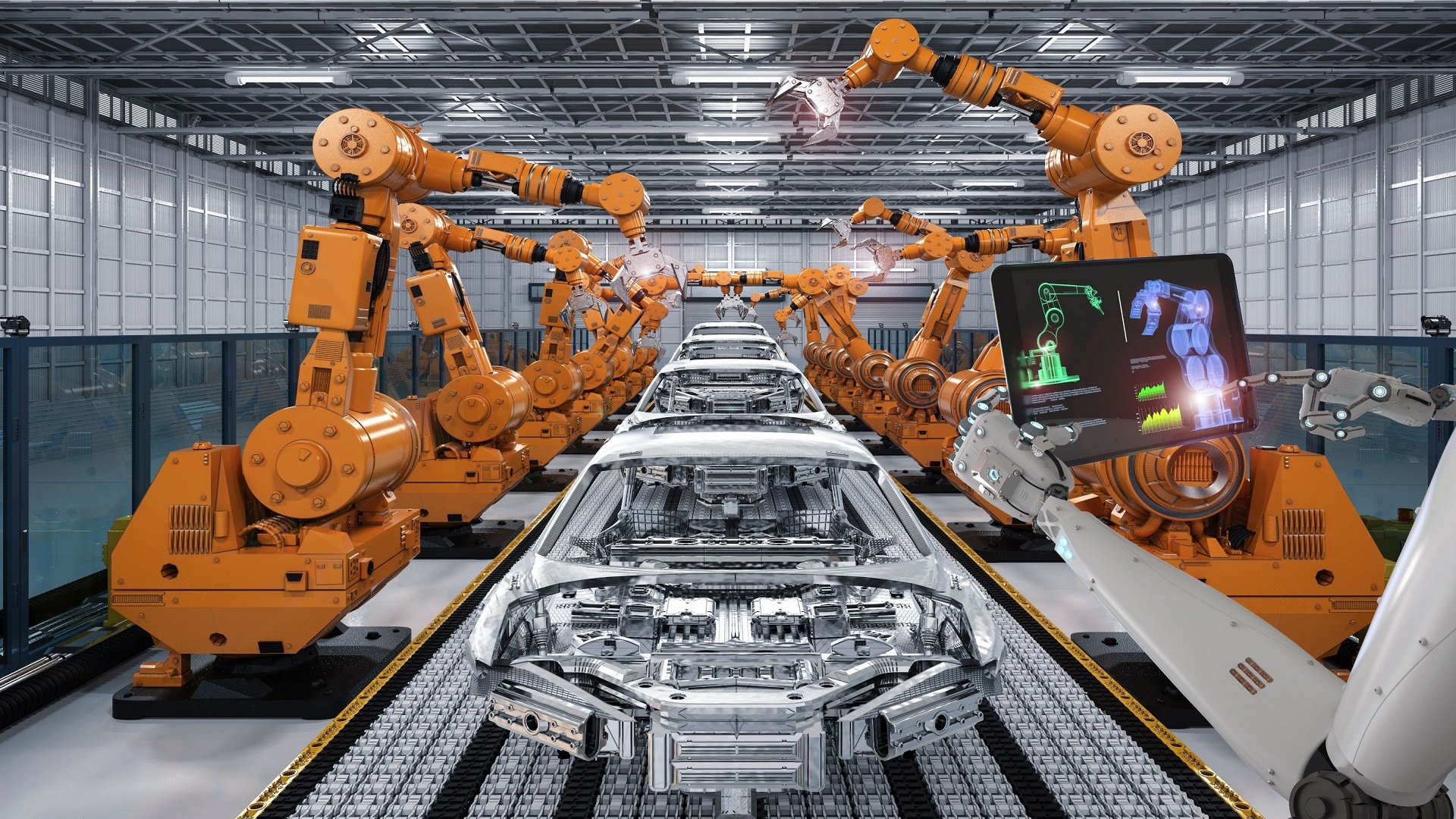
Manufacturing has always been closely connected with automation. Machines have replaced repetitive physical work, production lines have become increasingly sophisticated, and software now manages everything from inventory to purchasing. Yet, even highly automated factories often rely on people to interpret data, coordinate departments, prepare reports, identify problems, and decide what needs to happen next.
That is where artificial intelligence is creating a new opportunity.
AI can analyse information from machines, ERP systems, production records, quality inspections, inventory databases, maintenance logs, and supplier records. It can identify patterns, detect unusual behaviour, classify information, generate predictions, and support decisions that would otherwise require hours of manual analysis.
For manufacturers, this means AI is moving beyond the idea of a chatbot or a standalone analytics tool. It can become part of the actual operational workflow.
A production manager could use AI to evaluate scheduling constraints. A maintenance team could receive an early warning about abnormal equipment behaviour. A quality team could use computer vision to identify defects. Procurement could receive warnings about supplier delays. Management could receive operational reports without waiting for employees to compile information manually.
The opportunity is not to automate everything simply because AI makes it possible.
The opportunity is to identify the processes where AI can remove repetitive work, improve response times, reduce operational risk, and help employees make better decisions.
This article explores 15 manufacturing processes that businesses can automate or improve with AI and explains how these processes can become part of a broader intelligent manufacturing strategy.
Why AI Is Becoming Important in Manufacturing
Modern factories produce enormous amounts of information.
Machines generate operational readings. Quality systems record inspection results. ERP platforms track inventory and purchasing. Maintenance teams create service records. Sales teams generate customer orders. Production teams maintain schedules and output reports.
The challenge is that this information often exists in separate systems.
A production manager may know that a machine has been experiencing problems, while the maintenance team has the detailed equipment history. The procurement team may know that a supplier is running late, while production only discovers the potential material shortage when it becomes urgent.
AI can help connect these pieces of information.
Instead of simply displaying data, an AI system can analyse information from multiple sources and identify relationships that deserve attention.
For example, an AI system could identify that a particular production defect has increased after a machine begins showing abnormal operating behaviour. It could then connect that information with the affected production batches and maintenance history.
The system does not necessarily replace the engineer investigating the problem. It gives the engineer a much better starting point.
This is one of the biggest changes AI brings to manufacturing.
Traditional automation follows predefined instructions. AI can work with patterns, probabilities, unstructured information, and changing conditions.
That makes it useful for processes where the answer cannot always be described through a simple rule.
AI Automation Is Not About Removing People
Manufacturing requires human judgement.
Engineers understand machines and production processes. Quality professionals understand product requirements. Maintenance teams understand equipment behaviour. Production managers understand priorities and constraints that may not exist inside a database.
AI should support this expertise rather than automatically attempt to replace it.
A practical approach is human-in-the-loop automation.
AI can analyse the information.
AI can identify a potential problem.
AI can prepare a recommendation.
A human can review the recommendation and approve the appropriate action.
For example, an AI system may detect an unusual vibration pattern on a machine. Instead of automatically shutting down the equipment, it can alert the maintenance team, provide the relevant historical information, and recommend an inspection.
The human team can then decide what should happen.
This approach can provide manufacturers with the benefits of automation while maintaining control over important operational decisions.
15 Manufacturing Processes Businesses Can Automate
1. Production Planning and Scheduling
Production scheduling becomes complicated when a manufacturer has multiple customer orders, different machines, limited capacity, material constraints, maintenance requirements, and changing priorities.
A schedule that looks practical in the morning may become outdated by the afternoon.
A machine may fail. A supplier may delay an important component. A customer may request an urgent order. A production batch may take longer than expected.
Production managers often respond by manually adjusting spreadsheets, calling different departments, and checking multiple systems.
AI can reduce this workload.
An AI-powered scheduling system can analyse customer orders, machine availability, production capacity, material availability, maintenance schedules, historical production times, and delivery requirements.
It can then identify scheduling conflicts and prepare alternative scenarios.
For example, if a machine becomes unavailable, the system can identify which production orders are affected and analyse whether another machine can handle some of the workload.
The production manager can review the options and make the final decision.
This approach becomes even more useful when combined with custom business software development, allowing the AI workflow to reflect the manufacturer's actual production rules instead of forcing employees to adapt to a generic application.
Why AI Helps With Production Scheduling
The strength of AI in scheduling comes from its ability to consider multiple variables at the same time.
A traditional spreadsheet may contain production orders and available capacity.
An intelligent scheduling system can consider those factors alongside historical production performance, material availability, machine downtime, maintenance windows, and changing priorities.
The result is not simply a new schedule.
It is a more responsive planning process.
2. Predictive Maintenance
Equipment failure is one of the most expensive operational problems a manufacturer can face.
A failed machine can stop production, delay customer orders, increase overtime, require emergency repairs, and disrupt the schedules of other machines.
Traditional preventive maintenance reduces some of this risk by servicing machines according to predefined intervals.
However, fixed maintenance schedules do not always reflect the actual condition of equipment.
AI enables manufacturers to move toward predictive maintenance.
A predictive maintenance system can analyse signals such as vibration, temperature, pressure, operating speed, energy consumption, error codes, operating cycles, and historical maintenance records.
The system can learn what normal machine behaviour looks like and identify unusual patterns.
For manufacturers exploring AI-powered predictive maintenance solutions, the important objective is not simply predicting that a machine might fail.
The real value comes from connecting the prediction to an operational response.
The system could identify an anomaly, check the maintenance history, review upcoming production schedules, estimate the potential impact, and notify the appropriate maintenance team.
From Machine Data to Maintenance Action
Imagine a machine that normally operates within a consistent vibration range.
Over several days, the vibration gradually changes.
A human operator may not notice the trend because each individual reading still appears acceptable.
An AI system can analyse the trend across thousands of readings and identify that the machine's behaviour is changing.
The maintenance team can then investigate before the problem develops into an unexpected failure.
This turns maintenance from a primarily reactive activity into a more proactive process.
3. Automated Quality Inspection
Quality inspection is one of the most practical applications of AI in manufacturing.
Manufacturers can use computer vision and machine learning to analyse products, components, assemblies, surfaces, packaging, and other visual information.
Depending on the industry, AI can identify potential problems such as scratches, missing components, incorrect assembly, soldering issues, cracks, contamination, alignment problems, and surface inconsistencies.
For PCB manufacturers, for example, AI-powered quality inspection can analyse board images and identify potential defects based on trained inspection models.
The advantage is not simply speed.
Consistency is equally important.
Human inspectors performing repetitive visual inspections may experience fatigue or variations in judgement. AI systems can apply the same inspection criteria continuously.
However, human expertise remains valuable.
AI can identify potential defects while quality engineers investigate ambiguous cases, validate results, and decide whether a product should be accepted or rejected.
Turning Inspection Into Manufacturing Intelligence
Automated inspection also produces valuable data.
Instead of recording only whether a product passed or failed, manufacturers can analyse the types of defects occurring across different production lines, machines, batches, materials, and time periods.
This allows quality teams to identify trends rather than simply reacting to individual failures.
4. Defect Classification
Detecting a defect is only one part of quality management.
Manufacturers also need to understand what type of defect has occurred.
AI can classify defects into predefined categories, making large volumes of inspection information easier to analyse.
An electronics manufacturer, for example, might classify defects as missing components, incorrect components, solder bridges, insufficient solder, component misalignment, surface damage, contamination, or trace-related issues.
Once the defects are consistently classified, manufacturers can identify patterns.
If one defect category suddenly increases, the quality team can investigate.
If a particular defect appears mainly on one production line, engineers can examine the machines and processes associated with that line.
If defects are concentrated around a particular material batch, the quality and procurement teams can investigate the supplier.
Classification therefore becomes the foundation for more advanced quality analysis.
5. Root Cause Analysis
Manufacturing defects are often detected at one stage while their causes exist somewhere else.
A defective component may be identified during final inspection, but the underlying issue could have started with a raw material, machine setting, environmental condition, tool, production speed, or maintenance problem.
Finding these relationships manually can be difficult.
AI can bring information from different parts of the manufacturing operation together.
Suppose a manufacturer notices that a particular defect has increased during the last month.
An AI system could compare the defect against production batches, machine operating conditions, maintenance events, raw material lots, shifts, operators, and environmental information.
It may identify a pattern that deserves engineering investigation.
The important point is that AI does not automatically prove causation.
Instead, it helps engineers narrow down the possibilities and focus their investigation on the most relevant factors.
This can reduce the time required to move from a quality problem to a potential explanation.
6. Inventory Management
Inventory creates a constant balancing problem for manufacturers.
Excess inventory ties up capital and increases storage costs.
Insufficient inventory can interrupt production and delay customer orders.
The challenge becomes even greater when businesses manage thousands of components and raw materials.
AI can analyse inventory levels alongside production schedules, customer orders, historical consumption, supplier lead times, purchasing history, and expected demand.
This allows manufacturers to move beyond simply asking how much inventory exists.
They can begin asking whether the available inventory is sufficient for upcoming requirements.
For example, a component may appear adequately stocked today.
However, if several large production orders are scheduled for next week, the current stock may not be enough.
By connecting AI with ERP solutions, manufacturers can bring inventory intelligence closer to purchasing and production decisions.
From Inventory Monitoring to Inventory Prediction
Traditional inventory systems are often good at showing what exists.
AI can help estimate what will be needed.
This difference can improve purchasing decisions and reduce the risk of both shortages and unnecessary inventory.
7. Demand Forecasting
Manufacturing planning begins with understanding demand.
How much should be produced?
How much material will be required?
How much capacity will be needed?
How many employees may be required?
Poor forecasts can result in excess stock, underutilised capacity, or production shortages.
AI can analyse historical orders, seasonal patterns, customer behaviour, product-level demand, regional trends, and other business information.
The system can identify patterns that may be difficult to detect through manual spreadsheet analysis.
However, AI forecasting should not be treated as a guarantee.
Markets change and unexpected events occur.
The value is in continuously updating forecasts as new information becomes available.
A forecast that evolves with the business can be more useful than a static planning model created months earlier.
8. Procurement Automation
Procurement teams often spend large amounts of time performing repetitive activities.
They monitor inventory.
Review material requirements.
Request quotations.
Compare suppliers.
Track purchase orders.
Follow up on delayed deliveries.
Process supplier communication.
AI can automate parts of this workflow.
For example, the system can identify that a material is likely to become insufficient based on upcoming production requirements.
It can then review supplier information and prepare a purchasing recommendation.
AI can also process unstructured supplier documents and emails.
A quotation containing several pages of information can be analysed and converted into structured fields such as supplier name, product, quantity, price, delivery date, payment terms, and quotation validity.
The procurement team can then review the extracted information rather than manually entering every detail.
This does not eliminate procurement professionals.
It allows them to spend more time negotiating, evaluating suppliers, and making strategic decisions.
9. Supplier Risk Monitoring
Supplier performance has a direct impact on manufacturing performance.
A late delivery can become a production delay.
A quality issue can become a customer complaint.
A shortage of a critical component can stop an entire production line.
AI can monitor supplier performance continuously.
It can analyse delivery history, lead times, rejection rates, quality problems, order fulfilment, and other supplier-related information.
Suppose a supplier normally delivers a component within five days.
Over several orders, the average delivery time increases to eight days.
The change may appear small in isolation.
However, if the component is critical to production, the trend matters.
AI can identify the change and connect it with upcoming production requirements.
The procurement team can then investigate before the supplier issue becomes a production problem.
10. Energy Consumption Monitoring
Energy can represent a significant operating cost for manufacturing facilities.
Factories may have hundreds of machines operating under different conditions, schedules, and workloads.
AI can analyse energy consumption across machines, production lines, shifts, products, and operating periods.
The system can identify unusual consumption patterns.
For example, a machine may begin consuming substantially more energy while producing the same amount of output.
That could indicate inefficient operation or an equipment problem.
AI can also compare energy consumption against production output.
This helps manufacturers distinguish between higher energy usage caused by increased production and higher usage caused by inefficiency.
When connected with maintenance workflows, energy monitoring can become another source of equipment intelligence.
11. Automated Production Reporting
Production managers need reliable information.
How much was produced?
Which machines experienced downtime?
Which orders are behind schedule?
What was the rejection rate?
Which production line performed below expectations?
Yet creating these reports can consume hours.
Employees may need to collect information from several systems, clean the data, create spreadsheets, prepare charts, and write explanations.
AI can automate much of this reporting process.
A system can collect production output, downtime, rejection rates, machine utilisation, target performance, inventory information, and maintenance events.
It can then generate a structured operational report.
More importantly, AI can help highlight what actually deserves attention.
Instead of presenting a manager with hundreds of numbers, the system might identify that production output fell below target because of repeated downtime on one machine.
This turns reporting from a data collection exercise into a decision-support process.
12. Sales and Production Coordination
Manufacturing companies frequently face a gap between sales commitments and production capacity.
Sales teams want to satisfy customers.
Production teams have to work within real-world constraints.
A salesperson may see an available order opportunity while the production manager knows that the factory is already operating near capacity.
AI can help bridge this gap.
When a new order is received, the system can analyse existing orders, production capacity, machine availability, inventory, material requirements, and historical production times.
It can then provide an estimated production scenario.
Sales teams can use this information when discussing delivery expectations with customers.
Production teams can also understand the potential impact of new orders before commitments are made.
AI does not need to make the customer promise.
It provides the information required to make that promise more responsibly.
13. Maintenance Work Order Automation
Maintenance problems are often reported through informal communication.
An operator sends a message.
Someone makes a phone call.
Another employee writes the issue into a spreadsheet.
Eventually, someone creates a formal maintenance ticket.
This creates unnecessary administrative work.
AI can convert natural-language maintenance requests into structured information.
For example:
“Machine 7 is making an unusual noise near the motor.”
An AI system can identify the equipment, interpret the issue, check previous maintenance records, determine the appropriate workflow, and prepare a work order.
The request can then be routed to the relevant maintenance team.
Over time, these structured records also create a better historical dataset for predictive maintenance.
The simple act of automating work order creation can therefore contribute to more advanced maintenance intelligence later.
14. Document and Knowledge Management
Manufacturing businesses rely on enormous amounts of documentation.
There are operating procedures, maintenance manuals, quality instructions, machine documentation, safety procedures, product specifications, supplier documents, and internal policies.
Finding the right document at the right time can be surprisingly difficult.
AI-powered knowledge systems can make this information easier to access.
An employee could ask:
“What is the inspection procedure for this product?”
“Which maintenance procedure applies to this machine?”
“What tolerance should be used for this component?”
“What should the operator check before starting this production line?”
The system can retrieve information from approved internal documents and provide an answer based on that information.
This can reduce time spent searching through files.
It can also make organisational knowledge more accessible to newer employees.
Businesses can build custom software solutions around these knowledge workflows when standard tools do not fit their specific operational requirements.
15. AI-Powered Decision Support
Not every valuable AI application needs to automate an entire process.
Sometimes the greatest value comes from helping people make better decisions faster.
Manufacturing managers make decisions throughout the day.
Which production order should receive priority?
Which machine requires attention?
Which supplier needs to be contacted?
Which material should be purchased?
Which quality problem deserves immediate investigation?
Which production line is becoming less efficient?
AI can bring the relevant information together and provide context.
Instead of requiring a manager to check several systems, the AI can analyse the information and highlight the factors that matter.
This creates an AI-powered decision-support layer.
The manager remains responsible for the decision.
AI reduces the time required to understand the situation.
For many manufacturers, this is a practical way to introduce AI before moving toward more autonomous workflows.
How These 15 Processes Work Together
The real opportunity in manufacturing AI does not always come from automating one isolated process.
It comes from connecting processes.
Consider an electronics manufacturer.
An AI-powered inspection system detects an increase in soldering defects.
The system classifies the defects and identifies that most of them are coming from one production line.
AI then analyses machine information and discovers an unusual operating pattern.
The maintenance system shows that the machine has not received a particular service recently.
The production system shows that several important orders are scheduled on the same machine.
The system alerts the appropriate teams.
Maintenance investigates the equipment.
Production reviews the schedule.
Quality monitors the defect rate.
Management receives an updated report.
This is not one AI feature.
It is a connected workflow.
The value comes from allowing information to move between quality, maintenance, production, and management.
For businesses developing these types of workflows, AI integration solutions can help connect AI capabilities with existing business applications.
From Individual Automation to Connected Workflows
An isolated AI tool can solve a narrow problem.
A connected AI workflow can influence the broader operation.
For example, predictive maintenance becomes much more useful when it knows which customer orders are scheduled on the affected machine.
Inventory forecasting becomes more valuable when it can see upcoming production requirements.
Quality analysis becomes more powerful when it can access machine and supplier information.
This is where manufacturing AI starts moving from individual features toward an intelligent operational layer.
Example of an AI-Connected Manufacturing Workflow
A practical workflow might look like this:
- A machine generates operational data.
- AI detects an unusual pattern.
- The system checks maintenance history.
- AI evaluates the potential production impact.
- The system checks upcoming production orders.
- A maintenance recommendation is generated.
- A manager reviews the recommendation.
- A maintenance work order is created.
- Production scheduling is updated if necessary.
- The outcome is stored for future analysis.
Each step uses existing business information.
AI connects the information and helps coordinate the workflow.
Why ERP Integration Matters
Manufacturing businesses rarely operate from a single application.
An ERP system may manage purchasing, inventory, orders, finance, and production.
A CRM may contain customer information.
A quality system may contain inspection results.
Machines may generate operational data.
Maintenance software may contain equipment history.
AI needs access to relevant information if it is expected to support real manufacturing processes.
This is why AI should not be treated as a disconnected technology project.
A manufacturer could build an excellent AI model that predicts a production problem.
But if the prediction never reaches the production team, its business value is limited.
The workflow needs to connect prediction with action.
Connecting AI With Existing Manufacturing Systems
Manufacturers do not necessarily need to replace their existing technology stack.
An ERP system can remain the primary system of record.
A manufacturing execution system can continue managing production.
A quality platform can continue recording inspections.
AI can work alongside these systems and provide additional intelligence.
This can reduce disruption while allowing businesses to modernise gradually.
Turning AI Insights Into Business Actions
The difference between an AI report and an AI workflow is what happens after the insight is generated.
Suppose AI identifies a potential inventory shortage.
A useful workflow could check upcoming production requirements, identify the affected material, evaluate supplier lead times, prepare a procurement recommendation, and route the recommendation to the purchasing team.
The insight has now become an action-oriented process.
That is where AI automation becomes valuable.
AI Agents in Manufacturing
AI agents are becoming particularly relevant to manufacturers because many operational tasks involve multiple steps.
Traditional automation usually follows a predefined sequence.
AI agents can work with goals, information, tools, and defined permissions.
Consider a maintenance agent.
Its role could be to monitor critical equipment.
When abnormal behaviour is detected, the agent could:
- Review recent machine data.
- Check maintenance history.
- Compare similar previous incidents.
- Review the production schedule.
- Identify potential business impact.
- Recommend a maintenance window.
- Prepare a work order.
- Notify the responsible team.
The agent is not simply answering a question.
It is coordinating a workflow.
Businesses exploring this model can consider AI agent development for business workflows when they need AI to interact with multiple systems and perform several connected steps.
How AI Agents Differ From Traditional Automation
Traditional automation is usually deterministic.
If condition A occurs, perform action B.
AI agents can evaluate a wider range of information before determining what action should be taken within their defined boundaries.
That makes them useful for processes where the exact sequence can change depending on the situation.
Example of a Manufacturing Maintenance Agent
A maintenance agent could receive an equipment alert and then examine the machine's recent operating behaviour.
It could compare the data with previous maintenance events.
It could check whether similar problems have occurred before.
It could review the production schedule to understand the consequences of taking the machine offline.
It could then prepare a recommendation for the maintenance manager.
The human remains in control, but the administrative and analytical workload is reduced.
Manufacturing AI Requires Good Data
AI cannot compensate indefinitely for poor data.
If machine records are incomplete, inventory information is inaccurate, supplier records are inconsistent, or production data is stored in disconnected formats, AI implementation becomes more difficult.
Manufacturers should therefore evaluate data quality before launching large AI initiatives.
Important questions include:
- Where does the required data exist?
- Is the data structured?
- Is it updated consistently?
- Are different systems using the same terminology?
- Are historical records available?
- Can the systems communicate with each other?
- Who owns the data?
- Are there security restrictions?
Data preparation may not be the most exciting part of an AI project.
But it is often one of the most important.
Data Sources for Manufacturing AI
Manufacturing AI can draw information from many sources.
These can include ERP systems, MES platforms, machine sensors, quality systems, maintenance software, inventory databases, supplier records, customer orders, production reports, and internal documents.
The objective is not to connect every data source automatically.
The objective is to identify the information required for the specific business problem.
Preparing Data for AI Automation
Data may need to be cleaned, standardised, mapped, or structured before it can be used effectively.
Manufacturers should also establish clear ownership and access controls.
A well-designed AI system needs reliable information and appropriate permissions.
Building AI Around Existing Manufacturing Systems
Many manufacturers operate software that was implemented years ago.
These systems may still perform critical functions even if they were not designed for modern AI capabilities.
Replacing them completely can be expensive and disruptive.
A more practical approach may be to build an intelligence layer around the existing technology.
AI can access information from legacy applications while new workflows are gradually introduced.
This allows businesses to modernise without immediately replacing every system.
Modernising Legacy Manufacturing Software
Legacy systems do not necessarily need to disappear before AI can be introduced.
Integration layers, APIs, custom software, and automation workflows can create connections between older applications and newer AI capabilities.
This can provide manufacturers with a gradual modernisation path.
Connecting AI With ERP, MES and Other Systems
The most useful AI implementations often depend on multiple systems.
An AI system might use ERP information to understand orders and inventory, MES information to understand production, maintenance information to understand equipment, and quality information to understand defects.
Connecting these systems allows AI to operate with a broader view of the business.
The Human-in-the-Loop Model
There are manufacturing decisions that should not be fully automated.
Safety decisions are an obvious example.
High-value procurement decisions may also require approval.
Customer commitments may require commercial judgement.
Engineering decisions may require experienced professionals.
The solution is not necessarily to keep everything manual.
A human-in-the-loop model creates a middle ground.
AI analyses.
AI recommends.
AI prepares.
Humans review.
Humans approve.
Automation executes.
This model allows manufacturers to benefit from AI while maintaining appropriate control.
Where AI Can Work Independently
Low-risk, repetitive tasks are often suitable for higher levels of automation.
Examples include report generation, document classification, information extraction, routine alerts, and basic data processing.
Where Human Approval Is Required
High-impact decisions involving safety, significant financial commitments, production shutdowns, or customer obligations may require human review.
The correct level of autonomy depends on the process and the organisation's risk requirements.
How to Decide What to Automate First
A manufacturer could identify dozens of potential AI projects.
The challenge is deciding which one to start with.
A useful evaluation framework is to examine five factors.
Frequency
How often does the process occur?
Processes performed hundreds of times each week may offer more automation potential than processes performed once a month.
Manual Effort
How many employee hours are involved?
A process consuming significant administrative time may be a strong candidate.
Data Availability
Does the organisation have enough useful data?
A process with consistent historical information is generally easier to automate intelligently.
Business Impact
What happens if the process improves?
Reducing a few minutes of administrative work may be useful.
Reducing hours of machine downtime could have a much larger operational impact.
Risk
What happens if the AI makes a mistake?
Processes involving safety, large financial decisions, or critical production operations may require stronger human oversight.
Manufacturing AI Use Cases by Department
AI automation can affect almost every part of a manufacturing organisation.
Production
Production teams can use AI for scheduling, capacity planning, workflow monitoring, production reporting, and operational decision support.
Quality
Quality teams can use AI for visual inspection, defect classification, trend analysis, and root cause investigation.
Maintenance
Maintenance teams can use AI for predictive maintenance, anomaly detection, work order creation, and equipment history analysis.
Procurement
Procurement teams can use AI for supplier monitoring, purchasing recommendations, quotation processing, and delivery tracking.
Inventory
Inventory teams can use AI for demand forecasting, stock optimisation, shortage prediction, and material planning.
Sales
Sales teams can use AI to understand production capacity and provide more informed customer delivery expectations.
Management
Executives can use AI-powered reporting and decision-support systems to understand operational performance without waiting for manually prepared reports.
AI for PCB Manufacturing
PCB and electronics manufacturing is particularly suitable for AI because production processes generate large amounts of visual and structured data.
AI can support:
- Automated optical inspection
- Defect detection
- Defect classification
- Component verification
- Solder inspection
- Root cause analysis
- Predictive maintenance
- Production analytics
- Inventory forecasting
- Supplier quality monitoring
A PCB manufacturer could combine visual inspection with production and machine data.
If a particular defect begins appearing more frequently, AI can investigate whether the issue correlates with a specific machine, production batch, material supplier, or operating condition.
This creates a stronger quality management process than simply recording that a board failed inspection.
AI for Automotive Manufacturing
Automotive manufacturing involves complex supply chains, strict quality requirements, high production volumes, and significant equipment dependencies.
AI can support:
- Predictive maintenance
- Visual inspection
- Production optimisation
- Supplier monitoring
- Inventory forecasting
- Robotics optimisation
- Energy management
- Production scheduling
Because automotive manufacturing often operates at high volume, even relatively small improvements in downtime, quality, or production efficiency can have meaningful operational effects.
AI for Industrial Equipment Manufacturers
Industrial equipment manufacturers often deal with complex products, long production cycles, custom orders, and large amounts of technical documentation.
AI can help connect engineering, production, procurement, and customer information.
Potential applications include:
- Engineering document search
- Production planning
- Inventory forecasting
- Supplier management
- Quality analysis
- Maintenance
- Customer service automation
AI can also help employees find technical information more quickly.
AI for Pharmaceutical and Medical Manufacturing
Pharmaceutical and medical manufacturing environments require strong process control, documentation, traceability, and quality management.
AI applications may include:
- Quality monitoring
- Batch analysis
- Document processing
- Anomaly detection
- Equipment monitoring
- Production reporting
- Inventory management
In these environments, governance, validation, traceability, and human oversight are particularly important.
AI should be implemented within the organisation's applicable quality and compliance framework.
AI for Food and Beverage Manufacturing
Food and beverage manufacturers can use AI for production monitoring, quality inspection, demand forecasting, inventory planning, equipment maintenance, and energy optimisation.
Computer vision can assist with visual inspection.
Predictive maintenance can monitor processing equipment.
Demand forecasting can help align production with customer requirements.
AI can therefore support both operational efficiency and quality processes.
AI Automation and Legacy Manufacturing Software
Many manufacturers operate systems that were implemented years ago.
These systems may still perform important functions but may not have modern AI capabilities.
Replacing them completely can be expensive and disruptive.
AI integration can provide another path.
Businesses can build an intelligence layer around legacy applications and gradually connect them to modern automation.
This approach can help manufacturers modernise their operations without immediately replacing every existing system.
For businesses requiring broader AI-powered software development, modern AI capabilities can be introduced alongside existing enterprise applications.
Measuring the Success of AI Automation
AI projects should not be measured only by whether the technology works.
They should be measured by business outcomes.
Possible metrics include:
- Reduction in machine downtime
- Reduction in inspection time
- Reduction in defect rates
- Improvement in inventory accuracy
- Reduction in stockouts
- Reduction in manual reporting time
- Faster maintenance response
- Improved production schedule adherence
- Reduction in procurement processing time
- Improved supplier delivery performance
- Reduction in energy consumption
- Faster decision-making
The correct metrics depend on the use case.
A predictive maintenance project should not be measured using the same metrics as an AI document assistant.
Operational Efficiency Metrics
Manufacturers can measure processing time, labour hours, machine utilisation, downtime, production throughput, and schedule adherence.
Quality and Maintenance Metrics
Quality projects can track defect rates, inspection time, false positives, and recurring defects.
Maintenance projects can track downtime, response time, maintenance frequency, and equipment availability.
Financial and Business Metrics
Businesses can also evaluate inventory carrying costs, procurement savings, production losses, energy costs, and revenue affected by improved production capacity.
Common Mistakes Manufacturers Should Avoid
AI adoption can create problems when businesses focus on technology before understanding the process.
Automating Without a Clear Business Problem
AI should solve a real operational problem.
Starting with a technology and then searching for a use case can lead to unnecessary complexity.
Ignoring Data Quality
Poor data can produce unreliable AI outputs.
Manufacturers should evaluate data before building sophisticated workflows.
Trying to Automate Everything
Not every process needs AI.
Some workflows may be better handled through traditional automation or simple process improvements.
Removing Human Oversight Too Early
AI should not automatically receive authority over high-impact decisions simply because the technology is available.
The appropriate level of autonomy should be established gradually.
Building Disconnected AI Tools
A collection of unrelated AI tools can create another layer of complexity.
Manufacturers should consider how new AI workflows will connect with existing systems and processes.
A Practical Roadmap for Manufacturing AI
A manufacturing business can approach AI adoption through a structured roadmap.
Step 1: Map Existing Processes
Document the workflows currently used across production, quality, maintenance, procurement, inventory, and other departments.
Step 2: Identify Bottlenecks
Look for repetitive tasks, delays, manual data entry, frequent errors, and slow decision-making.
Step 3: Evaluate Available Data
Identify which systems contain the information required for automation.
Step 4: Prioritise Use Cases
Evaluate potential projects based on effort, value, risk, and data availability.
Step 5: Build a Focused Pilot
Choose one process and build a practical proof of concept.
Step 6: Keep Humans Involved
Define where AI can act independently and where employee approval is required.
Step 7: Connect Existing Systems
Integrate the AI workflow with ERP, CRM, MES, quality, maintenance, or other relevant systems.
Step 8: Measure the Results
Compare performance before and after implementation.
Step 9: Improve the Workflow
Use real-world feedback to refine the system.
Step 10: Expand
Once the first use case delivers measurable value, connect additional processes.
This approach allows manufacturers to build AI capability gradually rather than attempting a complete digital transformation in one project.
How Goalsr Helps Businesses Build AI-Powered Manufacturing Systems
Manufacturing AI is not simply a matter of connecting a chatbot to company data.
A useful manufacturing AI system needs to understand the operational process behind the data.
It needs to connect with existing software.
It needs to provide useful outputs to employees.
It needs appropriate permissions and controls.
Most importantly, it needs to solve a measurable business problem.
Goalsr works with businesses to develop custom AI and software solutions around their operational requirements.
Its AI development services can support businesses looking to introduce AI into analytics, automation, document processing, decision support, and intelligent workflows.
For organisations looking to modernise broader business operations, ERP solutions can provide a foundation for connecting operational data and business processes.
Goalsr can also help businesses explore AI agents when a workflow involves multiple systems, decisions, and actions.
The focus should remain on business outcomes.
If a manufacturer has a recurring quality problem, the objective is not simply to install an AI model.
The objective is to reduce the problem.
If maintenance teams spend hours analysing equipment information, the objective is to reduce that workload and improve maintenance response.
If production managers spend significant time building reports, the objective is to give them useful information faster.
AI is the technology.
The business process is the problem being solved.
The Future of Manufacturing Is More Connected
The next phase of manufacturing automation will not necessarily be defined by one revolutionary application.
It is more likely to emerge through many connected improvements.
A quality system becomes intelligent.
A maintenance workflow becomes predictive.
An inventory system becomes more responsive.
A production schedule becomes dynamic.
A procurement process becomes proactive.
A reporting system becomes conversational.
An ERP system becomes connected to AI agents.
Each improvement can make the overall manufacturing operation more responsive.
From Automation to Connected Intelligence
The important shift is from isolated automation toward connected intelligence.
Instead of simply asking whether a machine is operating, the business can ask what its condition means for production.
Instead of asking how much inventory exists, the business can ask whether the inventory is sufficient for upcoming demand.
Instead of asking how many defects occurred, the business can ask where the defects are increasing and what operational conditions may be associated with them.
From Data to Decisions
Manufacturing businesses already have large amounts of data.
The competitive opportunity increasingly comes from how quickly that data can become useful information and actionable decisions.
AI can help bridge that gap.
The factory of the future will still depend on people, machines, engineering expertise, and operational discipline.
AI can become the layer that helps these elements work together more intelligently.
Final Thoughts
Manufacturing businesses already have many of the ingredients required for AI automation.
They have machines.
They have operational data.
They have ERP systems.
They have production records.
They have quality information.
They have maintenance histories.
They have employees with years of operational knowledge.
The challenge is connecting these resources in a way that creates practical business value.
AI can help manufacturers automate repetitive processes, identify problems earlier, improve decision-making, and connect information across departments.
The 15 processes discussed in this article are only a starting point.
Production planning, predictive maintenance, quality inspection, defect classification, root cause analysis, inventory management, demand forecasting, procurement, supplier monitoring, energy management, production reporting, sales coordination, maintenance work orders, knowledge management, and decision support can all become part of a broader AI-enabled manufacturing strategy.
But manufacturers do not need to transform everything at once.
The better approach is to identify one process where the business already has a clear problem, sufficient data, and measurable potential value.
Solve that problem.
Measure the result.
Then build from there.
The opportunity is not simply to add AI to manufacturing.
It is to create manufacturing systems that can understand operational information, support employees, respond to changing conditions, and increasingly coordinate actions across the business.
The future of manufacturing will not be about humans versus AI.
It will be about how effectively people, machines, software, data, and intelligent systems can work together.