
Every business is looking for ways to automate repetitive work, reduce manual effort, and improve operational efficiency. But in 2026, automation is no longer limited to fixed rules and predefined workflows.
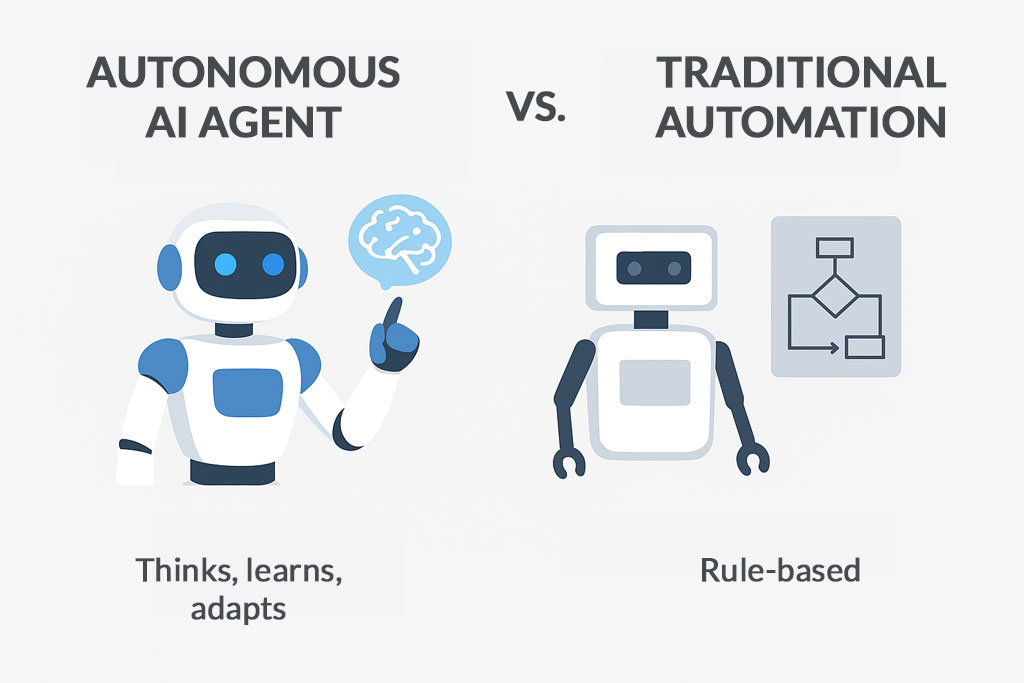
AI agents can understand context, work with unstructured information, make decisions within defined boundaries, and interact with multiple business systems. Traditional automation, on the other hand, remains highly effective for predictable and repetitive processes.
The real question is not whether AI agents are replacing traditional automation. It is which type of automation makes sense for a particular business process.
Why AI Agents Are Changing Business Automation
Traditional automation follows predefined instructions. If an event happens, the system performs a specific action.
AI agents work differently. They can interpret information, determine what needs to happen next, use connected tools, and adapt their actions based on the situation.
For example, a traditional workflow might automatically send an email whenever a customer submits a form.
An AI agent could go further:
- Read the customer's message
- Identify the customer's requirements
- Check information in the CRM
- Review previous interactions
- Determine the appropriate response
- Create or update a CRM record
- Assign the lead to the right sales representative
- Schedule a follow-up
This difference is becoming increasingly important as businesses adopt AI Agent as a Service and other intelligent automation solutions.
What Is Traditional Automation?
Traditional automation uses predefined rules, workflows, triggers, and conditions to execute tasks.
A simple example is:
If a customer completes a form → create a CRM record → send an email → notify the sales team.
The process is predictable because the inputs and required actions are already known.
Traditional automation works particularly well when:
- The process is repetitive
- The rules are clearly defined
- Data is structured
- The same action happens repeatedly
- Decisions do not require significant interpretation
- Consistency is more important than flexibility
Traditional automation can also be integrated into custom business software, ERP platforms, CRM systems, and other enterprise applications.
What Are AI Agents?
AI agents are software systems that can interpret information, reason about a task, use tools, and take actions toward a defined objective.
Instead of simply following one fixed workflow, an AI agent can determine which steps are required based on the situation.
For example, imagine a procurement department receives supplier emails containing quotations.
A traditional automation workflow may struggle if every supplier uses a different format.
An AI agent can potentially:
- Read the supplier email.
- Extract product and pricing information.
- Understand the quotation structure.
- Compare the information with the company's requirements.
- Identify missing information.
- Flag unusual pricing or quantities.
- Update the procurement system.
- Prepare a summary for the purchasing team.
The human employee can then review the result before taking the final action.
AI Agents vs Traditional Automation
The biggest difference is how each technology handles decision-making.
| Area | Traditional Automation | AI Agents |
|---|---|---|
| Workflow | Predefined | Adaptive |
| Data | Mostly structured | Structured and unstructured |
| Decisions | Rule-based | Context-aware |
| Flexibility | Limited | Higher |
| Predictability | Very high | Depends on model and controls |
| Human involvement | Usually limited | Can remain part of the workflow |
| Best suited for | Repetitive processes | Variable and complex processes |
This does not mean AI agents should replace every existing automation workflow.
In many businesses, the most practical approach is to combine both technologies.
Where Traditional Automation Still Makes Sense
AI is powerful, but traditional automation remains valuable.
A company should not introduce an AI agent simply because the technology is available.
If a process has clear rules and predictable inputs, conventional automation may be simpler to build, easier to test, and easier to maintain.
Consider a manufacturing company that needs to generate an invoice after an order is approved.
There is little reason for an AI agent to make this decision.
The workflow can simply be:
Order approved → generate invoice → update ERP → notify customer.
The rules are clear, the data is structured, and the required actions are predictable.
Traditional automation can therefore remain the right choice for:
- Invoice generation
- Scheduled reports
- Data synchronization
- Order status updates
- Notifications
- Employee onboarding workflows
- CRM field updates
- Database operations
- Routine approval workflows
- Inventory alerts
Where AI Agents Can Add More Value
AI agents become more useful when processes involve ambiguity, interpretation, multiple systems, or changing conditions.
For example, customer support requests rarely follow one standard format.
A customer might write:
"The machine we received last week is showing an error after approximately two hours of operation. We already restarted it twice and the problem is still happening."
An AI agent can interpret the message, identify the likely category, retrieve customer information, check previous tickets, search relevant documentation, and prepare the next action.
This type of workflow is difficult to handle using simple if-then rules.
AI agents can be useful for:
- Customer support
- Sales qualification
- Lead research
- Procurement analysis
- Document processing
- Internal knowledge search
- Email analysis
- Research workflows
- Data interpretation
- Multi-system business processes
AI Agents and ERP Systems
ERP systems contain some of the most valuable business information, including:
- Orders
- Inventory
- Customers
- Suppliers
- Financial data
- Production information
- Purchasing records
- Employee information
Traditional ERP automation typically relies on predefined workflows.
AI agents can introduce a more contextual layer on top of these systems.
For example, an AI agent could monitor purchasing information and identify situations that require attention.
It could potentially identify:
- Unusual purchasing patterns
- Supplier delays
- Repeated stock shortages
- Price changes
- Purchase orders requiring review
- Inconsistent supplier information
The agent could then prepare a summary for the purchasing manager rather than simply generating another report.
Businesses exploring this model can combine AI agents with existing ERP solutions rather than replacing the ERP itself.
AI Agents for Manufacturing
Manufacturing is another area where the difference between traditional automation and AI-based automation becomes important.
Traditional manufacturing automation is extremely effective for machine control and predictable production processes.
AI agents can complement these systems by working with information surrounding the production process.
For example, an AI system could analyse:
- Production reports
- Maintenance records
- Supplier communications
- Quality documentation
- Engineering notes
- Purchase orders
- Customer requirements
In PCB manufacturing, AI can also support engineering and front-end processes involving large volumes of technical information.
Businesses can explore AI-enabled PCB services where intelligent systems can complement existing engineering and manufacturing workflows.
AI Agents and Unstructured Data
One of the strongest use cases for AI agents is working with unstructured information.
Businesses receive enormous amounts of information through:
- Emails
- PDFs
- Documents
- Contracts
- Technical specifications
- Customer messages
- Supplier quotations
- Meeting notes
- Product documentation
Traditional automation usually requires this information to be converted into structured data before a workflow can process it.
AI systems can interpret the information directly.
For example, an AI agent could review a supplier quotation and extract:
- Product name
- Part number
- Quantity
- Price
- Delivery date
- Payment terms
- Additional conditions
It could then transfer the relevant information into another business system.
AI Agents vs RPA
Robotic Process Automation, or RPA, has already helped businesses automate repetitive desktop and application-based tasks.
RPA is particularly effective when the process is structured and the workflow is predictable.
AI agents extend this concept by adding interpretation and decision-making capabilities.
For example:
RPA
Open email → copy attachment → enter data into system → save record.
AI agent
Read email → understand the request → analyse attachment → determine the required action → use the appropriate business system → prepare the result.
The technologies do not necessarily need to compete.
An AI agent can determine what should happen while traditional automation or RPA executes specific tasks.
The Cost Question
Cost is an important factor when deciding between traditional automation and AI agents.
Traditional automation can be relatively straightforward when the workflow is simple and stable.
AI agent implementations may require additional investment in:
- AI models
- Infrastructure
- Integrations
- Security
- Monitoring
- Testing
- Governance
- Human review
- Ongoing optimization
The right comparison is therefore not simply the development cost.
Businesses should consider the total business value of the automation.
For example, an AI agent that reduces several hours of manual research every day may justify its additional complexity.
A simple notification workflow probably does not.
Security and Governance
AI agents can interact with sensitive business systems, which makes security and governance critical.
Before deploying an AI agent, businesses should define:
- What data can the agent access?
- Which systems can it interact with?
- Which actions can it perform?
- Which actions require human approval?
- What information should never be exposed?
- How are actions logged?
- How are errors detected?
- How can access be revoked?
An AI agent should not automatically receive unrestricted access to every business system.
A controlled architecture with permissions, monitoring, audit logs, and human approval can reduce operational risk.
Human-in-the-Loop AI Agents
Not every AI decision should be completely autonomous.
A human-in-the-loop model can be particularly useful for important business decisions.
For example:
AI agent → analyse purchase request → identify potential issue → recommend action → human approves → system executes.
This approach allows businesses to benefit from AI while keeping people involved where judgment or accountability matters.
Human review can be particularly important for:
- Financial decisions
- Contract approvals
- Customer escalations
- Procurement
- Compliance
- Production changes
- Sensitive communications
A Hybrid Automation Strategy
For many businesses, the practical solution will be a combination of traditional automation and AI agents.
A hybrid workflow might look like this:
AI agent → understands the request → decides which workflow is required → traditional automation executes the predefined steps → AI agent reviews the result → human approves when necessary.
This approach combines the flexibility of AI with the reliability of deterministic automation.
Businesses can use business process automation for predictable tasks while introducing AI agents where interpretation and contextual decision-making are required.
How to Decide Which Approach Your Business Needs
Before choosing a technology, examine the process itself.
Ask these questions:
- Is the process repetitive?
- Are the inputs structured?
- Are the rules clearly defined?
- Does the process require interpretation?
- Does the information come from multiple systems?
- Does the workflow change frequently?
- Does the process involve emails or documents?
- What happens when an exception occurs?
- Does the process require human judgment?
- What is the financial impact of errors or delays?
If the process is predictable and rule-based, traditional automation may be appropriate.
If the process requires interpretation, context, and interaction with different information sources, an AI agent may provide additional value.
A Simple AI Agent Readiness Framework
Businesses can evaluate potential AI agent use cases using five areas.
1. Process complexity
How many steps are involved?
Simple processes may not require an AI agent.
2. Data complexity
Does the process rely on structured databases or unstructured documents and conversations?
The more unstructured the information, the more useful AI can become.
3. Decision complexity
Does the workflow simply execute rules, or does someone need to interpret information before deciding what happens next?
4. Business impact
How much time, money, or operational capacity could the process improvement create?
5. Risk
What happens if the system makes a mistake?
High-risk workflows generally require stronger controls and human approval.
Examples of Processes and the Technology That May Fit
| Business Process | Traditional Automation | AI Agent |
|---|---|---|
| Invoice generation | Strong fit | Usually unnecessary |
| Scheduled reporting | Strong fit | Usually unnecessary |
| CRM data synchronization | Strong fit | Sometimes useful |
| Customer email classification | Limited | Strong fit |
| Supplier quotation analysis | Limited | Strong fit |
| Lead qualification | Possible | Strong fit |
| Document processing | Limited | Strong fit |
| Inventory alerts | Strong fit | Possible |
| Complex research | Limited | Strong fit |
| Fixed approval workflow | Strong fit | Usually unnecessary |
The important point is that there is no universal automation architecture.
The technology should follow the process.
What Businesses Should Avoid in 2026
One of the biggest mistakes businesses can make is introducing AI without first identifying the underlying business problem.
AI should not be implemented simply because competitors are discussing AI agents.
Businesses should avoid:
- Automating broken processes
- Giving agents unrestricted access
- Removing human review from high-risk decisions
- Using AI where simple rules are sufficient
- Building complex systems without measuring ROI
- Ignoring data quality
- Treating AI as a standalone technology instead of part of the business architecture
The goal should be measurable improvement, not simply adding an AI label to an existing workflow.
How to Start With AI Agents
Businesses considering AI agents can start with one well-defined process.
Look for a workflow that:
- Happens frequently
- Consumes significant employee time
- Involves multiple systems
- Contains repetitive research or analysis
- Has measurable outcomes
- Does not create unacceptable risk if partially automated
Start with a limited implementation.
Measure:
- Time saved
- Error reduction
- Processing speed
- Employee productivity
- Customer response time
- Operating cost
- Business outcomes
The results can then determine whether the workflow should be expanded.
Businesses looking for a structured approach can explore AI automation solutions designed around specific operational requirements.
The Future of Business Automation
The future of automation is unlikely to be purely traditional or purely AI-driven.
Businesses will continue to use deterministic automation for processes that require reliability and consistency.
AI agents will increasingly handle processes that require interpretation, reasoning, research, and coordination across systems.
The two approaches can work together.
A modern business architecture may therefore look like:
AI agents for understanding and decision support + APIs and integrations for connectivity + traditional automation for execution + humans for oversight and accountability.
This model gives businesses flexibility without abandoning the reliability of established automation technologies.
AI Agents vs Traditional Automation: The Bottom Line
Traditional automation and AI agents solve different types of problems.
Traditional automation is well suited to predictable, structured, rule-based workflows.
AI agents are better suited to processes involving variable inputs, unstructured information, contextual decisions, and multiple systems.
For many organizations, the most practical approach is not choosing one technology over the other.
It is identifying which parts of a workflow should be deterministic, which parts can benefit from AI, and where human oversight should remain.
The businesses that approach automation this way can build systems around actual operational requirements rather than technology trends.
Frequently Asked Questions
Are AI agents replacing traditional automation?
No. Traditional automation remains useful for predictable and rule-based processes. AI agents can complement traditional automation by handling tasks that require interpretation and contextual decision-making.
Are AI agents more expensive than traditional automation?
They can be, depending on the complexity of the implementation. The appropriate comparison should include development, infrastructure, maintenance, governance, and the expected business value.
Can AI agents work with ERP systems?
Yes. AI agents can be connected to ERP systems through APIs, integrations, middleware, or other controlled interfaces. They can help interpret information and initiate approved workflows.
Can AI agents replace employees?
AI agents can automate certain tasks and support employees, but the appropriate level of automation depends on the process, risk, business requirements, and governance model.
Should every business use AI agents?
Not necessarily. Some processes are better handled by conventional automation because they are simple, predictable, and rule-based.
How should a business start implementing AI agents?
Start with a specific, measurable business process. Evaluate its complexity, data, decision requirements, risk, and potential ROI before selecting the appropriate automation architecture.
Build the Right Automation Strategy for Your Business
The most effective automation strategy starts with the business process, not the technology.
Whether you need traditional workflow automation, AI agents, ERP integration, custom software, or a combination of technologies, the right architecture depends on your operational requirements.
Talk to the Goalsr team to discuss your automation requirements and identify where AI agents or traditional automation can fit into your business.